
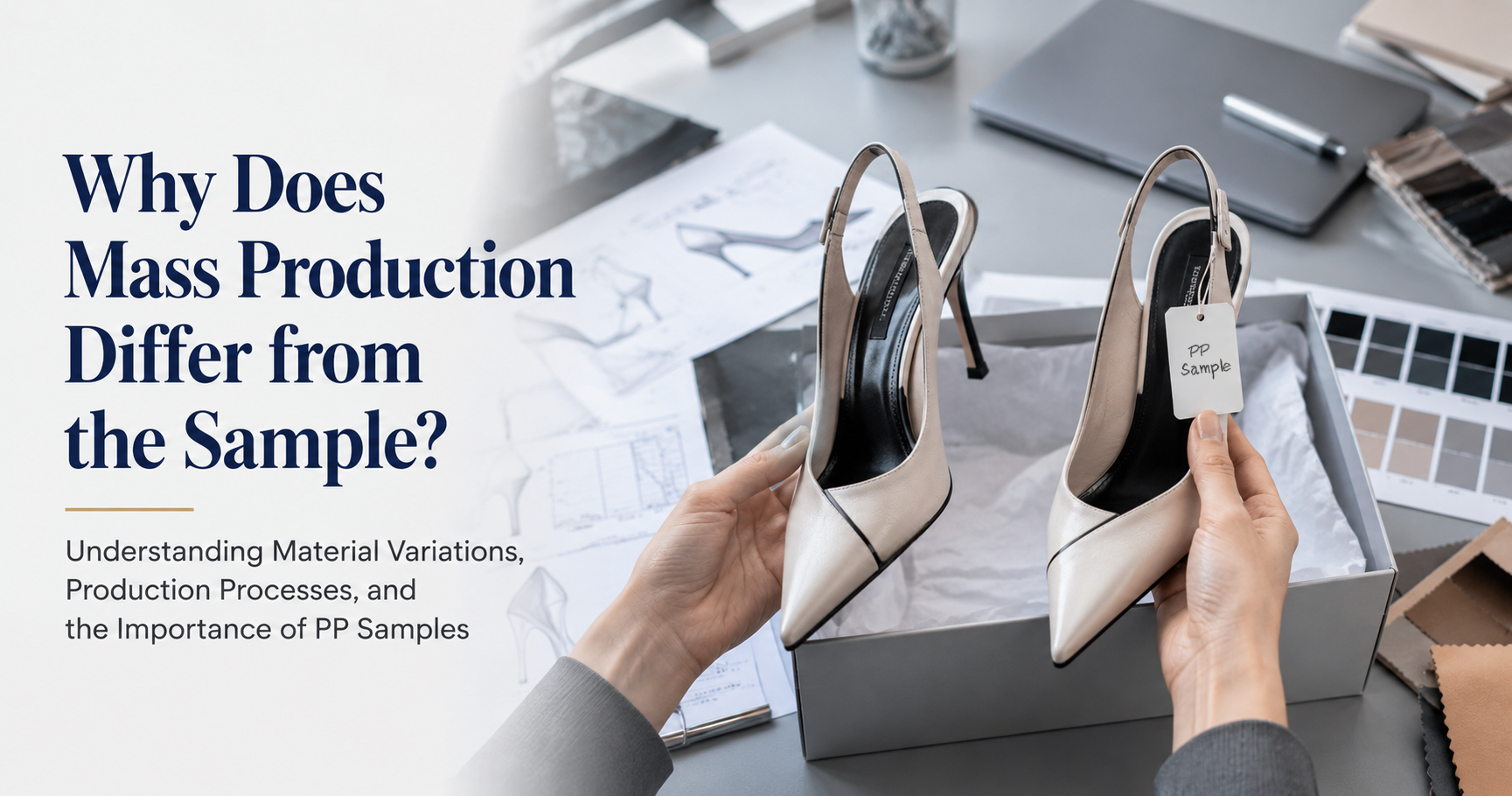
Understanding Why Bulk Production Doesn't Always Match Your Approved Sample
Many footwear brands have experienced this situation: the approved sample looks exactly right, but when the bulk order arrives, some details don't look quite the same. The color may be slightly different. The stitching may look less uniform. A material may feel a little different from the one used for sampling.
This naturally raises questions: Was something changed during production? Is the factory cutting corners? Or is this simply a quality issue?
The answer depends on the difference. Some variation is a normal part of scaling footwear from a small number of samples to thousands of pairs. Others should have been identified, communicated, and controlled before production started.
Small differences between samples and mass-produced shoes are normal in footwear manufacturing, but significant differences should be identified, communicated, and controlled before production begins. Understanding the difference between the two is important for any brand working with a footwear manufacturer.
Why An Approved Sample Doesn't Always Lead To Identical Production?
A sample and a production order are made under very different conditions.
· During sampling, a skilled sample maker may work on just one or a few pairs, with extra time to adjust details by hand. Materials may come from a single batch, and every part of the shoe receives close attention.
· Mass production is a different process. The same design must be produced repeatedly across hundreds or thousands of pairs, often involving multiple operators, production batches, machines, and material deliveries.
That doesn't mean the production shoes should be noticeably different from the approved sample. But it does mean that some small variations can occur.
Material variations are difficult to eliminate completely
This is particularly true for natural materials such as leather and suede, but fabrics and synthetic materials can also vary slightly between batches. Small differences in color shade, texture, or thickness may become more noticeable when materials are produced or purchased in large quantities.
This is why bulk materials should not simply be assumed to match the development sample. Whenever a material is critical to the final appearance of the shoe, it is worth reviewing the production material before manufacturing begins.
The key is to agree on what level of variation is acceptable rather than expecting every batch to be absolutely identical.
A handcrafted sample and a production line are not the same process
A sample maker can manually adjust stitching, folding, edging, or other details on an individual shoe. In mass production, those same operations need to be standardized so they can be repeated efficiently and consistently.
As production moves from one skilled individual to multiple operators and workstations, minor differences in finishing can happen.
A good manufacturer should understand which details are especially important to the design and establish clear production standards for them. For brands, it is equally important to communicate which details are critical rather than assuming that every aspect of a sample will automatically be interpreted the same way during production.
Tooling may be refined before production
Footwear production often involves lasts, cutting dies, molds, and other tooling that may be adjusted or finalized after the initial development sample.
These refinements can sometimes affect the appearance or construction of the finished shoe. In some cases, they are necessary to improve production consistency or ensure that the shoe can be manufactured reliably at scale.
The important point is communication. Changes that could affect fit, appearance, or product specifications should be discussed and approved before bulk production—not discovered when the finished order arrives.
The sample material may not always be available for bulk production
Sometimes the exact material used for development is only available in a limited quantity or is discontinued before production begins. A supplier may then need to recommend an alternative.
An alternative material can be perfectly acceptable, but it should never become a surprise after production. Brands should have the opportunity to review and approve any substitution, especially when it affects color, texture, comfort, or overall product positioning.
The Most Important Question: What Differences Are Actually Acceptable?
Not every difference between a sample and a production shoe should be treated as a defect.
Minor variations in natural material texture or small differences in hand-finished details may be unavoidable and may have no impact on the product's quality or performance.
However, differences that affect fit, sizing, durability, functionality, or the intended appearance of the shoe are a different matter. Incorrect materials, unapproved substitutions, visible construction problems, or changes to key design details should not simply be explained as “normal production variation”. This is where clear standards and communication make the biggest difference.
In our experience, many disputes between brands and manufacturers do not happen because one side intentionally made a mistake. They happen because expectations were never clearly defined before production began.
Why the PP Sample Matters?
The most effective way to reduce the gap between development and mass production is to review a Pre-Production (PP) Sample. A PP Sample should be as close as possible to the actual production shoe. Ideally, it is made after the main materials, colors, tooling, construction methods, and other key production details have been confirmed.
For brands, this is the point where it makes sense to step back and ask: If we approve this shoe today, is this really what we expect to receive in bulk?
A careful PP Sample review can help confirm the materials, color, fit, construction details, branding, and other critical requirements before production moves forward. Finding a problem at this stage is far easier—and far less expensive—than discovering it after thousands of pairs have already been completed.
For this reason, we generally see the PP Sample not just as another approval step, but as the bridge between product development and mass production.
Learn more about: How the shoe sampling process works before production
Production Consistency Starts Earlier Than Production
By the time a factory starts mass production, many important decisions have already been made. Material choices, construction methods, fit, tooling, and technical details are usually determined during development. If these areas have not been properly tested or clarified, production can expose problems that were already present earlier in the process.
This is why an efficient development process is valuable. It is not simply about getting a sample faster. It is about giving brands enough opportunity to review the product, validate materials, test fit when necessary, and resolve potential issues before larger production commitments are made.
At Singular, our development team works with brands through these stages to help identify potential production issues early and keep the transition from sampling to production as smooth as possible. The exact development timeline will always depend on the complexity of the design and material availability, but the goal is the same: resolve uncertainty before it becomes a production problem.
The better prepared a product is before production starts, the fewer surprises there are likely to be later.
What Brands Can Do To Reduce Production Differences?
There is no single step that can guarantee every production pair will be identical. Footwear manufacturing involves materials, people, machines, and processes, and some degree of variation is part of the reality of production.
What brands can do is reduce unnecessary variation by making sure that critical expectations are clear before production begins. That usually means reviewing bulk materials when appearance is important, maintaining clear technical specifications, confirming any changes before production, and taking the PP Sample approval seriously.
It also helps to work with a manufacturing partner that is willing to raise potential issues early rather than waiting until they become problems. In practice, early communication is often more valuable than trying to fix issues after production has already started.
FAQ: Sample vs. Mass Production
Q: Why do mass-produced shoes sometimes look different from the approved sample?
A: Samples are usually made in very small quantities, often with more manual attention and materials from a limited batch. Mass production involves larger quantities, multiple operators, production tooling, and potentially different material batches. Small variations can occur as a result, but significant changes should be identified and addressed before shipment.
Q: Can a footwear factory guarantee 100% consistency?
A: Realistically, no manufacturer can guarantee that every pair will be absolutely identical, particularly when natural materials are involved. The goal of professional production management is to keep variations within agreed and acceptable standards while maintaining consistent quality across the order.
Q: What is considered an acceptable variation?
A: Generally, an acceptable variation is a small difference that does not affect the shoe's fit, function, durability, or intended overall appearance. Material substitutions without approval, incorrect sizing, visible defects, or major construction differences should not be considered normal production variation.
Q: Why is a PP Sample important?
A: A PP Sample gives the brand an opportunity to review a version of the shoe that closely represents the planned bulk production before the order is fully manufactured. It helps confirm that the product, materials, construction, and key requirements are aligned before production commitments become much larger.
Final Thoughts
Small differences between a sample and mass-produced shoes are part of footwear manufacturing—but they should not be treated as an excuse for poor quality or poor communication.
The goal is not to expect mass production to reproduce a handcrafted sample with impossible perfection. The goal is to understand where variation can occur, define what is acceptable, and put the right approval process in place before production begins.
For brands, the strongest protection is a well-managed development process, clear specifications, careful material and PP Sample approvals, and open communication with the manufacturing team.
When potential issues are identified early, mass production becomes much more predictable—and the final product is far more likely to meet the expectations that were set at the beginning.